The Secret SuperPower Of Meditation.

Meditation…What is it really all about?yogi-hulk-diffuse-anger

Most would claim that Meditation, (commonly imagined as sitting silently, becoming aware of the present moment or of one’s breath), brings about a greater sense of calmness, clarity, serenity, and contentment. A break from the incessant chatter of the unstoppable inner voice clanging around in our heads. This, of course, is absolutely true. And then, there are all the benefits to our health, like reduced blood pressure, stress release, increased oxygen levels… it’s a long list, and all of it good stuff.

But what happens when we leave the cushion?  When we roll up our mat? When the commentary in our heads starts running again?  We are back in our thoughts, anxieties, and judgments. How quickly we lose our serenity and sense of ‘one-ness’. How easily we return to business as usual. Here is where we could be missing the greatest benefit that Meditation actually has to offer.

Let’s use the analogy of going to the gym or doing yoga, martial arts, or whatever physical pursuit scratches our itch. We do our workout, our practice or exercise. During and just afterward, we often feel a nice warm rush in our bodies. Our bloodstream is flooded with yummy dopamine and we’re glowing and maybe even a bit high. Great feeling, but we know that it is not this immediate ‘hit’ that motivates us to keep going.  What really gets us to commit to our practice is an understanding that over time, we are building and training our muscles to feel stronger, our heart and lungs to be more effective, increasing our physical ability and developing our body to work at its optimum.  Making it as capable as possible of handling what modern life throws at it. We know we will be more able to deal with unexpected physical stress and strains, we’ll have fewer aches and pains.

We can dance all night, and do…other things.. all night. We feel less fatigue, more awake, sharper and fitter.  In short, we become healthier and have a better quality of life.

Applying this understanding to Meditation is what will give us the secret superpower that is almost always overlooked.

When we meditate on a daily or very regular basis, we are in fact strengthening our ‘presence muscle’. That is to say, we are building our capacity to become present and aware when we really need it most – not on the mat or cushion, but when our sore points, our vulnerable places, are triggered in our ‘normal’ day to day activities.

When all is smooth and wonderful in life, we are mostly content, happy and connected. But when the shit hits the fan, when we are triggered, by our parents, our partners, our children, friends or work colleagues, it is in these moments of ‘reaction’ that we ‘lose consciousness’.

This moment is where we snap.  It’s where we defend, rationalize, attack, manipulate and either act ‘out’ in aggression or act ‘in’ through passive anger, punishment or just total shut down. This is when we actually feel the sting of abandonment, resentment, envy, and fear in real-time and space. This is where we damage ourselves and others.

Meditation’s greatest gift is that it can train us to expand that moment. It allows us to stretch that nano-second of time, just as we are triggered, offering to us an extra split second of hard-won presence and awareness.  A capacity built over time, as we cultivate our ability to witness our thoughts and emotions from a higher perspective.

This little gap, this fleeting blink of an eye, is where the practice of Meditation manifests its most profound benefit.

In that extra interval lies the greatest power available to us.  The capacity to choose how we will deal with the rush of pain, fear or anger welling up inside. It gives us the capacity to slow down time, take a breath and allow the emotional charge to subside so that we can make a conscious decision about how we want to respond. This shift enables us to move from automatic conflict, towards resolution. From judgment to compassion. From anger to forgiveness. From fear to love.

It should though be understood, that this fundamental ability, this knack, is by no means easy, nor is it always welcomed by those around us. When we develop this capacity, we become uniquely empowered, as we step out of ‘character’ and no longer follow the scripts that have been playing out in the theatre of our lives. Others who are used to being able to trigger and control us, are suddenly left having to deal with their own thoughts and feelings because we are no longer playing along and feeding the fire. We have learned to take each moment, each criticism, each comment that once had us lashing out in desperation and rage, and see it for what it really is…someone else’s inner world, their reality, not ours. We no longer take it personally.

This does not mean that we are no longer capable of hearing a valid criticism or are unable to receive feedback about where we can change, learn and grow.

We can, in fact, remain more receptive, more discerning and better placed to make a healthy judgment as to whether we take on or dismiss what comes our way from others.

With less fire and smoke comes clearer vision and understanding.

In the coolness of presence, we respond from our deepest, true nature.

This is real inner power.

This is ‘spiritual fitness’.

This is the secret superpower of Meditation!

Am I a Predatory Male?

menThe air is thick with it. A choking, cloying, cloud of guilt.  A dense fog of shame and self-doubt.
Men are gasping for clean air, for vision, for direction. We are looking outward, at the explosion of revelations and accusations of sexual abuse, misconduct, and harassment towards women.  Looking in, we are evaluating, assessing, judging ourselves.

“Where am I on the spectrum?”

Where indeed?

“what is ok to say?” “What Can’t I say? “Is this flirting or is it harassment?” “Am I a ‘good’ man?” “Have I always treated women with respect, dignity, and honesty?”

“Or am I a ‘bad’ man?” “Have I ever left a woman feeling demeaned, abused or frightened?” “Ever scanned her body with lust in my eyes and pure animal desire in my loins?” “Have I ever ‘persuaded’ or coerced her to let me into her deepest enclaves?”

What every man knows, if he is honest, is that within us, we all have the capacity, even perhaps the tendency, toward sexual control, conquest, domination, and subjugation. The very idea of it releases chemicals and hormones into our bloodstream.

To what extent we are first, conscious of these visceral forces and secondly, how well we are able to transmute them into gentle intimacy, sensitivity and respect, is the extent to which we can call ourselves ‘good’ men.  It is a very fine line to walk.

We want to feel our masculinity, our power, our potency. We relish the fire of desire burning within us. We want to release the beast that would ravish and consume innocent beauty.

But, we as 21st-century men, are not merely animals; subject to the blindness of instinct and passion. We have evolved to become more than our primordial drives. Hidden, deep in the dungeons of our darkest thoughts and fantasies, what men truly seek is connection. Closeness. Love.

In the pure heart, in the sentient being of every man, we yearn for intimacy.  No boy is born abusive or violent. We are all in essence subject to the same needs. To be seen, touched, adored, loved, desired, accepted.

So what is the difference between a good man; kind considerate, respectful, gentle, trustworthy and a bad man; abusive, manipulative, controlling, aggressive and violent?

The answer is strategies. Good men employ strategies to get their needs met and so do bad men. Some strategies make women feel appreciated, respected, well treated and loved. Other strategies make them feel abused, used, controlled and in danger, but it is all still strategies.

So then, why would any man choose strategies that would hurt, frighten or disrespect a woman or a man for that matter to whom they are attracted? Why would a man consciously attempt to coerce, demand, force or threaten in order to get his needs met?

The current generation of middle-aged men, myself included, were brought up in a culture that tolerated if not occasionally promoted the idea of racial prejudice and sexual misogyny. We grew up watching ‘Carry on’ films where women were objectified and abused as part of the script. This is what is being acted out by so many men now because we are still using the strategies that were modeled to us at a young age. This in no way lets us off the hook. Responsibility for our actions is ours as are the consequences.

Things were different in the 70s, its true. Values and behaviours that we now take for granted were not commonplace. Not just in the realm of sexuality but also in racial equality, homophobia, xenophobia, respect and care for those with disabilities and so much more. I sometimes watch TV clips from 70s comedy shows that would, and could never be even conceived, let alone written and broadcast today.

There has been an evolution.  Society has become more sensitive and more discerning. We now ask more of ourselves. We demand a higher standard of self-awareness, of values, of behaviour. Just as slavery and apartheid went from acceptance to first condemnation and eventually abolition, our society now demands that as men, we raise our game. That we know we are now subject to a higher bar, a higher level of self-awareness and self-regulation. What was ok is now not ok because that is how we grow as Human Beings.

I was able to grow into adulthood and learned to not mistreat or abuse women. As a boy, I did not slap girls on the butt at school or pull their bra straps. Even though it was ‘ok’ then. Some girls even appeared to like the attention. But I could not bring myself to do it. I actually felt like a weirdo because I was too shy to ‘flirt’ in that way.

I was raised by my parents to be a kind, respectful and gentle person so, no matter what fantasies fly through my head, my behaviour to women is and always will be, considerate and kind. This is what I have passed on to my two sons. This is why they also are kind and loving to women. And this is what it all comes down to. Teaching our sons what a good man is. Modeling what a good man does. Setting the example based on an evolved future, not an anachronistic past. Good men become good fathers. Good fathers raise good sons who then become even better men.

As the media splashes out condemnation and accusation, deriding the ‘awful, disgusting, perverts’ that have now been so heroically ‘exposed’, let’s not just scream at them to be better men. They were using the strategies they thought best. It was all they had and for some, all they will ever have. There are millions of Harvey Weinsteins and Louis CKs out there that nobody hears about. Men that go on abusing and harming women day after day, unseen and unhindered.

Condemnation cannot be the final response. It must be a clarion call to awaken and empower good men to become good fathers, good women to be good mothers and together raise good sons. That is the solution. That is the evolutionary path. Let my generation be the last one that fails to provide the right strategies to their young men.

If we can be good role models, leading by example and make integrity, honesty, and respect, the drivers of our values, then eventually, we will see the end of women suffering at the hands of men.

The Inner Child – Healing and Healer


When I connect with my inner child, seeking to heal and grow, I sometimes wonder, who is really doing the healing? Am I saving my inner child or is he saving me?

Have the skills, resilience, and experience that I have gained as an adult, come at the cost of childhood’s long-lost qualities?

Qualities like Spontaneity, courage, wonder, trust, and curiosity. The thirst to learn and experience new things. A purity of spirit, sensing life as an enchanted and magical experience. These all still exist within the deepest part of my being, my uninhibited and unrepressed self. In connecting to my inner child, I am looking not just to reassure and reconnect with what may be a lot of fear and repressed emotions but also, to reconnect with the wonderful simplicity of being a child and bringing that essence into my adult life.

I was never a ‘difficult’ child. I was not a troublemaker, but I was a rebel.  I questioned authority and power, even when, with great resistance, I would comply with demands and instructions.

I would do as I was told, eventually, but often my inner disagreement remained. In school, I was excellent at subjects I enjoyed, but crap at those that I found too demanding or simply boring. I would confront teachers and staff without hesitation if I felt that I was being called out for irrelevant or pedantic issues like school uniform or losing interest in their mind-numbingly boring classes.

Perhaps, being raised by very alternative thinking parents, instilled in me a sense that the whole education thing was about conditioning me to become a pawn in society’s game and was something to be wary of, something to push back against, to preserve my natural dignity as a perfect being. I don’t know.

What I do know is that it did not win me many friends. In fact, I suffered chronic bullying all through my school career, due to my being an unusual type of person, with a different take on life, living in a fairly provincial, small-minded environment.

I have always loved my rebellious nature. It feels intrinsic to me, something that I brought with me into the world. I did not learn it or cultivate it. It is a part of what I am. Honestly, I have always had this feeling that I am somehow meant for greatness. Destined for something meaningful and important. For better or worse it has had me on occasion, act with an entitlement and audacity that can leave those around me a bit shocked. I’m not saying that I am special, but somehow I act as if I am. I admit it, I fancy myself big time and yes, I have come down crashing on many occasions. I have to really work at accepting criticism and often fail, especially if I feel judged as well. But at the source of that is a strong energy. A force of wisdom and understanding within me, my inner child is not going to take any nonsense and I love him so much for that because, often he did have to take it and just put up with being abused, accused and targeted.

Born of this innate quality, there has arisen in me a realization; an understanding that has changed my inner state, more than any practice, epiphany or insight ever has. It takes the form of an intention. A statement. I have decided that I am through with feeling scared about life. Yes, I learned to feel fear as a child but I also learned to find courage in the challenges of youth.

As a ten-year-old, I remember the first time I jumped from the highest diving board at my local swimming pool.  I recall having to mentally force one foot in front of the other as I slowly approached the edge of the board, looking down at the water and just freezing with fear. It was so much higher from up there. My heart thumping, feeling totally petrified. One half of me frantically trying to find a way to back out without looking a coward in front of my friends, the other half knowing that this challenge was actually doable and that I would survive.

I had to do it. But how could I gather the courage?  In the end, it came down to a moment – a single moment of commitment. I had to push myself to go beyond the point of no return and just trust.  With my toes touching the edge and looking down at the distant water, I knew that all I needed was to feel strong enough and brave enough for just one second in time. One instant to change everything!

Forcing myself forward, fighting against my survival reflex, I jumped.  Dropping… gasping in as I pinched my nose shut.

I slammed into the water, a chaotic bomb of bubbles and noise. I sank all the way to the bottom, pushed off and headed back up. The moment I surfaced, fear was replaced with an elation and empowerment that only comes with a major victory against a perceived limitation. Almost like a birth – a new part of me.  A released capacity, a new self-appreciation. The realization that I can do this thing and from now on, I will always be able to do this thing!

That memory and many others from my childhood and teenage years have helped me to understand more about how fear moves in my life today. How it affects the choices I make and the consequences of those decisions. It has become such an essential tool for breaking out of my comfort zone.

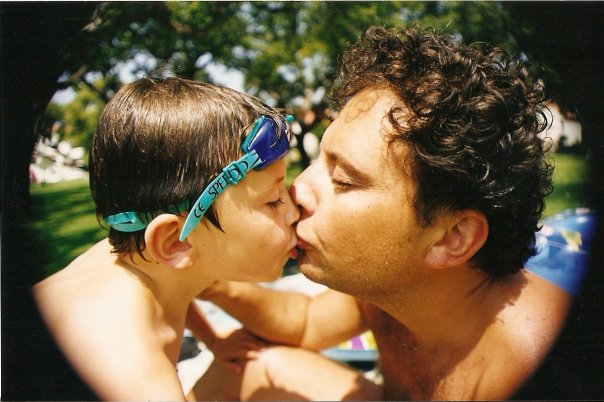
Marc and his son Jerome aged seven

So I cultivate and encourage this two-way relationship within me. As much as I seek to heal that young boy, I also seek his counsel, his courage and together we push through our barriers. It is not a denial of fear, nor a delusion that I have no fear but more of a joyful rebellion. It’s a bit like calling the bluff on the automatic fear response. When it comes, I immediately connect with the boy.  I reassure him that all is well. I talk to him with tenderness and love, never criticizing, never judging, just loving and accepting. Then my inner child gets his face on. He steps up and says, “Is that all you’ve got?  Bring it on!

Continue reading “The Inner Child – Healing and Healer”

Tears – Our Healing Force.

The Science of Crying. Tears Can Reboot your Genetic Code!

Repression kills our emotions. All of them. Our sadness, despair, and abandonment are all safely locked away, out of sight and out of our conscious mind.  Repression also buries our joy, our feeling of connection,

of being loved, valued and accepted for who we are.

From our earliest moments of life, we are compelled to control and inhibit our natural expressions of laughter and crying. We are forced to abandon the most basic and uniquely human form of language.

It is well known and understood.  That in order to begin to ‘feel’ again, to live with an exposed and open heart, we have to risk encountering loss, grief, and loneliness. So we find ourselves trading in intimacy and emotional bonding in order to avoid the emptiness and fear born of our deep, hidden painful memories. Our un-expressed and unheard cries for safety and security, for love and acceptance.

In his groundbreaking book ‘The New Primal Scream’Arthur Janov describes how our brains handle extreme trauma and emotional overwhelm. He explains that the brain has a particular way of coping with more stress than the body can handle. He states…

“Ordinarily, neural information about hurt is relayed to the Thalamus. When the pain is not overwhelming, information is then sent to the hypothalamus which initiates a variety of responses, including crying. That makes up the healing process.  When repression exists, information and tears are rerouted away from the hypothalamus. If this did not occur, the excesses of hypothalamic activity in blood pressure, pulse, and temperature, for example, would be lethal. It is therefore important that the hypothalamus not accept all of the input. The excess neural energy of the pain is rerouted and finds its neurotic destination in the Limbic system and it is because of this bifurcation that full healing cannot take place”.

Basically, he is saying that as infants and children, when we are forced to deal with more fear, trauma or pain than we can handle, the brain puts some of the emotion into deep storage where it is locked away, and so we can no longer cry and release this element of the wound. It does this to protect the organism, to keep us alive!  Over time, the Limbic system fills with more and more ‘censored’ pain and the effects on our bodies and lives from this emotional pool of unfinished business manifests as many dysfunctions. These can include psychological problems including self-sabotage, addictions or other types of anesthetics, which allow us to function with some sense of normality. It also affects our physiology. Our bodies become sensitive and we may develop allergies, intolerance to certain foods and damage to the immune system. It can even repress diseases that can lie dormant in our systems, unable to be exposed and treated and so continue to poison us throughout our lives.

But there is an even more dramatic effect that is less well known about what happens to our bodies during a lifetime crippled by early repression.  Stinted by the inhibition of our freedom to express both our pain and our joy. Our evolutionary pattern or genetic code that runs our bodies during our life can actually stall in the face of deep repression! This means that we are running on a faulty code, a fundamentally dysfunctional system breakdown at the level of our DNA. Our ‘operating system’ begins to crash.

So when we begin the process of reactivating the lost pain and traumatic memories, when we begin consciously healing ourselves by allowing the limbic system to re-open and slowly release the old wounds. We are actually allowing our bodies genetic code to reboot. We are in effect, switching ourselves off and on again! This is why it so crucial to find a way to open this portal and begin the process of revisiting and releasing this deeply buried mass of pain and sorrow.

Janov goes on to write…

“Weeping is healing. Feeling is healing.  Repression is ‘anti-healing’. Every process of our brain and body has an evolutionary rationale.  To block weeping is to run against the sweep of evolution. That is why those who weep deeply seem to ‘restart’ the evolutionary process – beards begin to grow at age forty, wisdom teeth develop at forty-five, breasts begin to grow at age thirty-five.    

The genetic code can now proceed to its destination;  that destination is growth, healing, and health.  Not a bad job for minuscule droplets of moisture. Imagine!  Tears have the power to transform our physiology, change our personality and re-fire the evolutionary engine. What has seemed like weakness to so many of us turns out to be one of the most powerful forces on earth”!  

Dump the script and step off the stage!

StageEven if it is our belief that we live many lives, we still only get to live this particular life once. With this script and this cast.

Looking at the average kind of circumstances that existence hands out across 7 billion people, how blessed are we to have this life? Safe and secure enough to explore the deepest truths available to humanity.

Most people would give limbs to have half our opportunities and environment, with such relative security and stability. A life of comparative luxury, allowing us the time and space to discover our most fundamental limiting beliefs. The very core issues at the heart of our ‘story’, and the power to make positive change.

But it is essential to remember that doing something positive with our lives doesn’t mean we avoid negative consequences and reactions from others and ourselves.

There are ALWAYS, perceived or believed negative consequences for any challenge we face.

If there weren’t any, then we would be doing or would have done it by now.

So we need to really feel into what our perceived fears are.

They may be hidden and subtle. we are very used to making excuses for ourselves and finding external reasons to not act in our highest self.

For instance, take physical health. We all know exactly what is required to achieve optimum health for our age and circumstances. That is not a mystery. There would appear to be no negative consequences in getting fit and healthy. But they are there. If we begin to exercise and work on stretching and strengthening our bodies, there will be the challenge of feeling pain and exhaustion. If we become conscious of our eating, then we fear to feel hungry, or are forced to find a new way to deal with cravings, and eating to contain fear or emotional turbulence.

If we want to heal ourselves because we feel unwell, then we have to get real about our illness and take responsibility for our recovery.

Everybody wants to feel well and healthy but we don’t want to face the feelings that the challenge will bring. We don’t want to have to heal ourselves. Everybody wants to have the best possible quality of life, but few are ready to overcome the obstacle they face to achieve that.

Every day we make small repeating choices, habits, rituals, call them what you like, and those small decisions all work toward a certain outcome. So making real change, going beyond the point of no return, means to make a daily, in fact, at first, an HOURLY conscious commitment to empowering the decision. the change will be permanent if the inner commitment is permanent too.   so this is about turning up the awareness level to our actions and assessing their impact on our decisions.  No small action is either judged as good or bad, just the question comes – ‘is this action aligned with my decision to grow or not’? It’s almost like giving away the part we normally play, the thought we have and the words we say. it’s like letting go and handing it to something bigger than us. trusting that true inner voice over the louder entrenched voices.

It’s about turning our focus to see the STRUCTURE of limiting belief, Inhibition, self-sabotage, and addiction. NOT THE CONTENT! Why?

The metaphor is thus.

There is the theatre of life. In that theatre, there is a stage and an auditorium.

If we are on the stage, and ‘in character’ – we are playing our roles and following the script that we have committed to memory. (our beliefs and conditioning). We are in the play – in the movie, absorbed by the plot, the other characters, and our part in the story.

somewhere inside, we know that this is just a play, – a performance, – a script. But we also know that if we don’t follow the script, we will upset all the other actors and their roles will be exposed and invalidated. We have to stay in character – (behave ourselves and keep up the status quo). Not just to protect ourselves, but also to protect the integrity of the illusion for everyone else. Even if we don’t like the script, even if we see that the story is just that – an imagined reality, we still maintain our roles because we don’t want to be ejected from the stage.

We only know the stage and nothing else.

So if we see the idea of raising our awareness as a growing realization that we are on this stage, then the first thing we will want to do, is to see what exists beyond the stage. Beyond the script and the roles laid out for us. We feel compelled to start writing our own script. We crave spontaneity and creativity. We seek to find something beyond what we see and hear every day.

But how do we awaken from the dream? How do we get off the stage? We cannot ease our way out of unawareness, we cannot gently dip one toe into the void and expect to see what is beyond. In the end, we have to move to the front of the stage and jump into the darkness. We have to take the leap. Knowing that we may never be able to return to the illusion of our story, our script, our roles. We need to be ready for the character to die so that the actor can become self-aware and see that we are now no longer on the stage.

Now we are in the auditorium.  We are the director, the writer, the producer. Now we see that our beliefs and conditioning are not actually real any more than we decide they are and we get to write a new scene. A great liberation but also a great responsibility.

Now, if we don’t like the story we are writing, to whom can we complain? Who can we look to blame for our lives?

Ok, we get the idea of letting go of the character, but we have to interact with our world. We have to live in the marketplace. Eventually, we will have to get back on the stage, but now, we are the authors of our reality and can never again be just an actor, reciting the old script and the old moves. Now we are back in the play, but we are no longer in character. We have become self-aware and responsible for creating our own plot. This is a very different experience because we are now aware that we are on a stage and that we are not living according to the story going on around us. This may severely piss off some of the characters on the stage. The cast of your life. They will not be able to rely on you to fit the script anymore. They will feel destabilized and abandoned because they cannot take their cues from you in the same way anymore. You are now in the game but not OF it.  This can be a very lonely place. This is why we need courage. Why we need to learn how to integrate this new disillusionment into a life that still includes connection, intimacy, love, and community while retaining our innate sovereignty. Our own completeness.

We integrate through active contribution and giving of our selves in service. Part of the task of an awakened person is to share their realization with those around them and more generally, their fellow travellers. To assist them to also be liberated from the stress and anxiety of keeping up a performance, a set of roles and staying in character 24 hours a day, 365 days a year.

Personal transformation happens when we stop chopping and start digging!

Interior


Most (not all) but most ideas, theories, processes, and methods on offer today for personal growth and development, are conceived, directed and taught through the conscious mind. We sit and share our inner world, we try to work through our limiting beliefs, our patterns of sabotage and negative behaviour using all kinds of setups, communication, meditations to help us to ‘understand ourselves’. We watch our thoughts, our breath, our behaviour.

And we get it! We understand! We see our stuck, repeating issues. We feel our fear and projections of the unknown. We really do see how our past has been creating our future. Yes, yes, YES!! WE GET IT!!!

And yet, many of us are still stuck.  Still hopeful. Ever willing and ready, open and receptive, coachable and present. Ready to try again and again.

I believe that transformation –  the experience of a real permanent shift –  lies in one tiny, hidden place.

It lies in our healing.  In our hidden pain, in our subconscious fear, our contained joy, and spontaneity. It lies in our laughter, in our tears, and in our surrender. It lies in the world of the invisible, the entombed and ignored.

The real challenge involves going into that place so terrifying and overwhelming, that many of us spend most of our waking lives committed to shutting down every and any real road to that bridge. Any distraction will do. Drugs, sex, food, drama, TV, Personal Development courses, even meditating and chanting mantras can all work well as strategies to ‘avoid the void’.

It’s like this.  Imagine a giant bunch of weeds growing in front of us on our life path. A huge, sun blocking, thorny thicket of weeds, 50 feet high, 10 feet wide and 20 feet deep. All our patterns, our issues, our sabotage, are all there in this monstrosity. Yes, we have some serious tools at our disposal.  We’ve done the ‘inner work’ right?  We’ve done every ceremony, every ritual, we’ve drunk sacred medicine and now we have our spiritual axe and a machete of intention and we know how to use them. We hack and cut,  with determination and commitment and purpose.  And some weeds start to come down. We get a glimpse of the light beyond, the hope of progress. But, as we step forward, new weeds rear up again and quickly block our path and the light beyond. We are back to square one and begin, once again, to hack away at this giant obstacle. We get a bigger axe, a sharper sword, we develop our technique and stamina but no matter how much we try, we cannot overcome this giant monster.

These weeds are being fed in the world of the invisible. The subconscious realm. Deep in the soil of our long forgotten, unresolved pain, frustration, abandonment, loneliness and sadness.  These roots feed and support this insatiable organism.

There is only one way to stop this cycle of perpetual struggle. We need to forget about the weeds we can see. We need to forget about the stories, the content, the ‘stuff’ that makes up our conscious lives.

We need to stop chopping. We need to start digging!

Dropping our axes, dropping our technique and our determination, we fall to our knees and surrender to the reality that we need to venture into the darkness – to descend into our interior.  This is when we fully understand that we can no more access our subconscious through the conscious mind than we can force ourselves to fall asleep at night.

We have to use a much more primal power to connect to this hidden inner world – to access the protected parts of our brain that contain and store all our wounds, pain and trauma. We have to use our basic primal energies.  Like a newborn child, as yet un-enslaved by thought, we have to reconnect to our laughter and intrinsic joy, and we have to connect with our tears.  Fully, deeply, and in utter abandon and surrender.

Now, we are digging.

As our hands push into the dark damp soil, as we journey into our hidden depths, using nothing but our receptivity and presence, we begin to enter into a different state of awareness. We are exploring without our minds. Just using our pure primal energies. Inviting both the repressed joy and pain to surface.

And then, slowly, something begins to take shape in our hearts. Our wounded child awakens, memories return, feelings begin to well up from a distant past. But now, we are here for our inner child. Now, we have resources, experience, resilience. Now we are ready to expose these treasures, these blessings in disguise.  With patience, compassion, and awareness, we gently ease the wound, the root, into the light. We welcome it. We hold it in our hands. We love it, we accept it, and then, as it begins to dissolve in the light of a memory revealed and the salt of our deepest tears…..we let it go.

As we do, a few towering stems wither and gently fall away, allowing in new light, new warmth.  And, when we’re ready, we move forward and again, we begin to dig.

And slowly, gently, we reveal more and more of the roots of hidden pain and fears that have lain buried and dismissed. Each one discovered purely by digging down deep inside, our only tools, our heart, our desire to heal and to discover the deepest essence of what we are.

As the giant weeds continue to fall away, the path begins to clear. We step forward, growth happens, our life begins to develop and change automatically. As we are breathed by existence, as blood circulates through our body, as all the natural systems do, so will our life naturally move toward balance, toward awareness, toward Love.

“Hey! I’m just telling the truth!” Welcome to the Dark Side of Honesty.

In 1979 at the age of 15, while living on his Ashram in Pune India, I asked a question of my Guru.

“How do we stay true to our own honesty and still be sensitive to other people’s feelings?”

I don’t remember the whole answer but the gist of it was that we are all responsible for our own feelings and deciding that we are ‘being hurt’ by others is always a choice and a reflection of our own insecurities. If someone feels hurt, that is their pain for them to own and deal with.

I took the answer and agreed with it in principle but I still had to figure out how to apply it in my life with the people I related to and cared about. This has proved to be a lifelong challenge and is still a work in progress.

What I have discovered is that there is so much more to honesty than just telling the truth. We have to also have integrity, authenticity on many levels and also vulnerability if we are to be sensitive to others while ‘telling it like it is.’

Being honest is a favourite tool of passive aggression and can be used to intentionally hurt or diminish another while hiding behind the veil of perceived truthfulness. Everything from “yes honey, actually your bum does look big in that” to “I can’t keep it in any longer, I am seeing someone else” can be a way of punishing and controlling another, especially when we know they are vulnerable or fragile. We all tell white lies to children or anxious friends and relatives because we love them and care that they don’t worry unnecessarily. We are protecting them. We also restrict and monitor ourselves in relationships to ensure we don’t push buttons or activate triggers. this is a strategy to protect ourselves from the consequences of ‘authentic behaviour.’

There are schools of thought that promote absolute authenticity as the only way of living an honest life. But authentic to what?
Ourselves, our partner, our children, our community, country or spiritual practice? Can we always override those around us so that we get to be honest and ‘authentic?’ Is that utterly selfish and if it is, is that ok or not?

In the end, it must come down to our intention. The conversation we can have with ourselves is, “I really want to be honest right now but why do I want to be honest”? Am I doing this to manipulate and control another’s emotions or thoughts? Am I doing it because the truth needs to be heard, the wound healed and the connection deepened, or because I don’t really care as long as I get to unburden myself and speak my mind freely?

If we can be honest within ourselves first as to our intention, then we can make a decision as to how, or if at all, we need to confess, judge, inform or enlighten someone else. That is true multidimensional authenticity, that is how we be true to ourselves, remain clear in our heart and soul and still take care of others and their feelings.

I believe it is important to remember that being authentic starts with our behaviour, not our words. If we betray someone’s trust, that is the issue we face. keeping it a secret is just a strategy, neither good nor bad. The act of betrayal, the lie, the conceit is where we lose integrity, where we become inauthentic and that is what can create pain and suffering in others, not the secret itself. Attempting to heal ourselves through so-called honesty and ‘coming clean’ have nothing to do with being true to ourselves.

So Honesty has a light and dark side, depending on our reasons to keep quiet or not and on our taking responsibility for how we feel first about what we are communicating.

The One Basic Concept That Can Completely Transform Your Relationship With Your Children And Yourself!

Trust + respect = influence.
Trust +respect= influence.

I have, with their mother, raised two boys, now aged 29 and 30, and a stepdaughter aged 37. They are inspired, energized, healthy and balanced individuals because of one very basic but critical concept. Getting this new understanding and applying it can change the actual viewpoint from which we parent and so transform the very experience of raising a child.

Many of us feel that our children need to be protected and directed in order that they turn out as successful individuals. Others believe that parents should befriend their children to maintain trust and a happy relationship, by giving them space to evolve, without being controlled or coerced into a future that we think is best for them. In my experience, both these approaches lead to disaster!

Either a child experiences domination and suffocation or the alternative, being neglect and ‘boundary-less’ choice paralysis.

So how do we care for our children, help them and protect them? How do we decide which approach and how much stick to carrot is the right balance?
Well, here is a concept that can create an environment of healthy communication, clear, empowered roles and functional family connections.

The Concept is simply to move from having expectations of our children…. to having aspirations for them. That is it.

Just shifting our perspective from one to the other, switches the focus to where it belongs; with the child. Moving to aspiration means that we want the best for them. We want them to be self-reliant, inspired, creative, and healthy but inside ourselves, we accept that it may not turn out that way. Our children may face challenges, suffering and difficulty in their lives and on a deep level as parents, we need to accept that as a possibility and realize that they are here to live out their own stories.

When we think, speak, and direct from a place of expectation, we are attempting to engineer our children in order that they live out our story. In expectation, there is an agenda presented to the child and this is felt within them as invalidation, as disrespect, and as an experience of the parent, in essence, becoming the child.

We expect them to be successful not just because we love them but also because we need to be validated as parents through their achievements. A child feels this as an energetic abandonment, even if we are supportive and apparently ‘focused’ on the child.

This is the birthplace of unhealthy rebellion, of seeking identity through a separation that is beyond the natural desire to leave the nest. It is the root of self-sabotage. Where failure becomes the power, where identity is developed in a negative self-evaluation. This core issue is the environment in which the relationship between child and parent becomes conflictive, abusive, or even violent. This is how we can potentially cripple our children for life.

It’s not an easy shift but when we realize that we can, in aspiration, guide, support, care for and encourage, facilitate and organize, teach, and connect. Then we see that our children open up to the experience of our role in their lives.

In aspiration, we can build trust and influence, the two essential ingredients needed to protect and inform our children.

So the concept of aspiration allows for all the important dynamics of parenting; guidance, wisdom, support, and nurturing but also sincerity, boundaries, and responsibilities. It creates clear roles, for authentic modeling and allows for appropriate, lifelong friendships to develop within a safe, creative, and loving family space. This has been my experience and I am filled with gratitude for the strong and solid bond that I have with my children.