
Am I a Predatory Male?

menThe air is thick with it. A choking, cloying, cloud of guilt.  A dense fog of shame and self-doubt.

Men are gasping for clean air, for vision, for direction. We are looking outward, at the explosion of revelations and accusations of sexual abuse, misconduct, and harassment towards women.  Looking in, we are evaluating, assessing, judging ourselves.

“Where am I on the spectrum?”

Where indeed?

“what is ok to say?” “What Can’t I say? “Is this flirting or is it harassment?” “Am I a ‘good’ man?” “Have I always treated women with respect, dignity, and honesty?”

“Or am I a ‘bad’ man?” “Have I ever left a woman feeling demeaned, abused or frightened?” “Ever scanned her body with lust in my eyes and pure animal desire in my loins?” “Have I ever ‘persuaded’ or coerced her to let me into her deepest enclaves?”

What every man knows, if he is honest, is that within us, we all have the capacity, even perhaps the tendency, toward sexual control, conquest, domination, and subjugation. The very idea of it releases chemicals and hormones into our bloodstream.

To what extent we are first, conscious of these visceral forces and secondly, how well we are able to transmute them into gentle intimacy, sensitivity and respect, is the extent to which we can call ourselves ‘good’ men.  It is a very fine line to walk.

We want to feel our masculinity, our power, our potency. We relish the fire of desire burning within us. We want to release the beast that would ravish and consume innocent beauty.

But, we as 21st-century men, are not merely animals; subject to the blindness of instinct and passion. We have evolved to become more than our primordial drives. Hidden, deep in the dungeons of our darkest thoughts and fantasies, what men truly seek is connection. Closeness. Love.

In the pure heart, in the sentient being of every man, we yearn for intimacy.  No boy is born abusive or violent. We are all in essence subject to the same needs. To be seen, touched, adored, loved, desired, accepted.

So what is the difference between a good man; kind considerate, respectful, gentle, trustworthy and a bad man; abusive, manipulative, controlling, aggressive and violent?

The answer is strategies. Good men employ strategies to get their needs met and so do bad men. Some strategies make women feel appreciated, respected, well treated and loved. Other strategies make them feel abused, used, controlled and in danger, but it is all still strategies.

So then, why would any man choose strategies that would hurt, frighten or disrespect a woman or a man for that matter to whom they are attracted? Why would a man consciously attempt to coerce, demand, force or threaten in order to get his needs met?

The current generation of middle-aged men, myself included, were brought up in a culture that tolerated if not occasionally promoted the idea of racial prejudice and sexual misogyny. We grew up watching ‘Carry on’ films where women were objectified and abused as part of the script. This is what is being acted out by so many men now because we are still using the strategies that were modeled to us at a young age. This in no way lets us off the hook. Responsibility for our actions is ours as are the consequences.

Things were different in the 70s, its true. Values and behaviours that we now take for granted were not commonplace. Not just in the realm of sexuality but also in racial equality, homophobia, xenophobia, respect and care for those with disabilities and so much more. I sometimes watch TV clips from 70s comedy shows that would, and could never be even conceived, let alone written and broadcast today.

There has been an evolution.  Society has become more sensitive and more discerning. We now ask more of ourselves. We demand a higher standard of self-awareness, of values, of behaviour. Just as slavery and apartheid went from acceptance to first condemnation and eventually abolition, our society now demands that as men, we raise our game. That we know we are now subject to a higher bar, a higher level of self-awareness and self-regulation. What was ok is now not ok because that is how we grow as Human Beings.

I was able to grow into adulthood and learned to not mistreat or abuse women. As a boy, I did not slap girls on the butt at school or pull their bra straps. Even though it was ‘ok’ then. Some girls even appeared to like the attention. But I could not bring myself to do it. I actually felt like a weirdo because I was too shy to ‘flirt’ in that way.

I was raised by my parents to be a kind, respectful and gentle person so, no matter what fantasies fly through my head, my behaviour to women is and always will be, considerate and kind. This is what I have passed on to my two sons. This is why they also are kind and loving to women. And this is what it all comes down to. Teaching our sons what a good man is. Modeling what a good man does. Setting the example based on an evolved future, not an anachronistic past. Good men become good fathers. Good fathers raise good sons who then become even better men.

As the media splashes out condemnation and accusation, deriding the ‘awful, disgusting, perverts’ that have now been so heroically ‘exposed’, let’s not just scream at them to be better men. They were using the strategies they thought best. It was all they had and for some, all they will ever have. There are millions of Harvey Weinsteins and Louis CKs out there that nobody hears about. Men that go on abusing and harming women day after day, unseen and unhindered.

Condemnation cannot be the final response. It must be a clarion call to awaken and empower good men to become good fathers, good women to be good mothers and together raise good sons. That is the solution. That is the evolutionary path. Let my generation be the last one that fails to provide the right strategies to their young men.

If we can be good role models, leading by example and make integrity, honesty, and respect, the drivers of our values, then eventually, we will see the end of women suffering at the hands of men.

The Inner Child – Healing and Healer


When I connect with my inner child, seeking to heal and grow, I sometimes wonder, who is really doing the healing? Am I saving my inner child or is he saving me?

Have the skills, resilience, and experience that I have gained as an adult, come at the cost of childhood’s long-lost qualities?

Qualities like Spontaneity, courage, wonder, trust, and curiosity. The thirst to learn and experience new things. A purity of spirit, sensing life as an enchanted and magical experience. These all still exist within the deepest part of my being, my uninhibited and unrepressed self. In connecting to my inner child, I am looking not just to reassure and reconnect with what may be a lot of fear and repressed emotions but also, to reconnect with the wonderful simplicity of being a child and bringing that essence into my adult life.

I was never a ‘difficult’ child. I was not a troublemaker, but I was a rebel.  I questioned authority and power, even when, with great resistance, I would comply with demands and instructions.

I would do as I was told, eventually, but often my inner disagreement remained. In school, I was excellent at subjects I enjoyed, but crap at those that I found too demanding or simply boring. I would confront teachers and staff without hesitation if I felt that I was being called out for irrelevant or pedantic issues like school uniform or losing interest in their mind-numbingly boring classes.

Perhaps, being raised by very alternative thinking parents, instilled in me a sense that the whole education thing was about conditioning me to become a pawn in society’s game and was something to be wary of, something to push back against, to preserve my natural dignity as a perfect being. I don’t know.

What I do know is that it did not win me many friends. In fact, I suffered chronic bullying all through my school career, due to my being an unusual type of person, with a different take on life, living in a fairly provincial, small-minded environment.

I have always loved my rebellious nature. It feels intrinsic to me, something that I brought with me into the world. I did not learn it or cultivate it. It is a part of what I am. Honestly, I have always had this feeling that I am somehow meant for greatness. Destined for something meaningful and important. For better or worse it has had me on occasion, act with an entitlement and audacity that can leave those around me a bit shocked. I’m not saying that I am special, but somehow I act as if I am. I admit it, I fancy myself big time and yes, I have come down crashing on many occasions. I have to really work at accepting criticism and often fail, especially if I feel judged as well. But at the source of that is a strong energy. A force of wisdom and understanding within me, my inner child is not going to take any nonsense and I love him so much for that because, often he did have to take it and just put up with being abused, accused and targeted.

Born of this innate quality, there has arisen in me a realization; an understanding that has changed my inner state, more than any practice, epiphany or insight ever has. It takes the form of an intention. A statement. I have decided that I am through with feeling scared about life. Yes, I learned to feel fear as a child but I also learned to find courage in the challenges of youth.

As a ten-year-old, I remember the first time I jumped from the highest diving board at my local swimming pool.  I recall having to mentally force one foot in front of the other as I slowly approached the edge of the board, looking down at the water and just freezing with fear. It was so much higher from up there. My heart thumping, feeling totally petrified. One half of me frantically trying to find a way to back out without looking a coward in front of my friends, the other half knowing that this challenge was actually doable and that I would survive.

I had to do it. But how could I gather the courage?  In the end, it came down to a moment – a single moment of commitment. I had to push myself to go beyond the point of no return and just trust.  With my toes touching the edge and looking down at the distant water, I knew that all I needed was to feel strong enough and brave enough for just one second in time. One instant to change everything!

Forcing myself forward, fighting against my survival reflex, I jumped.  Dropping… gasping in as I pinched my nose shut.

I slammed into the water, a chaotic bomb of bubbles and noise. I sank all the way to the bottom, pushed off and headed back up. The moment I surfaced, fear was replaced with an elation and empowerment that only comes with a major victory against a perceived limitation. Almost like a birth – a new part of me.  A released capacity, a new self-appreciation. The realization that I can do this thing and from now on, I will always be able to do this thing!

That memory and many others from my childhood and teenage years have helped me to understand more about how fear moves in my life today. How it affects the choices I make and the consequences of those decisions. It has become such an essential tool for breaking out of my comfort zone.

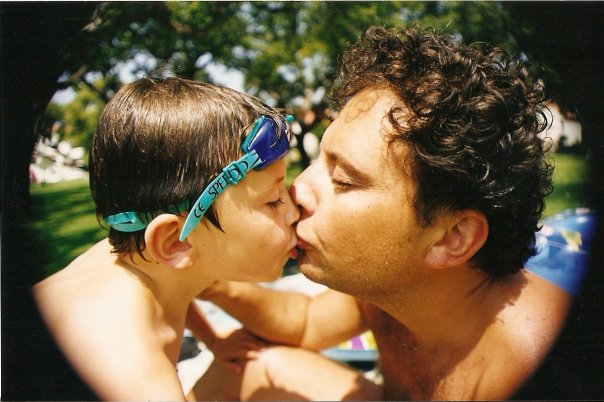
Marc and his son Jerome aged seven

So I cultivate and encourage this two-way relationship within me. As much as I seek to heal that young boy, I also seek his counsel, his courage and together we push through our barriers. It is not a denial of fear, nor a delusion that I have no fear but more of a joyful rebellion. It’s a bit like calling the bluff on the automatic fear response. When it comes, I immediately connect with the boy.  I reassure him that all is well. I talk to him with tenderness and love, never criticizing, never judging, just loving and accepting. Then my inner child gets his face on. He steps up and says, “Is that all you’ve got?  Bring it on!

Continue reading “The Inner Child – Healing and Healer”

What is the difference between ‘Letting go’ and ‘giving up’?

during this time of uncertainty and change, it seems that so many people are finding themselves at a crossroads in their lives.

In our careers, in relationships, health, and well-being, or in the never-ending quest for meaning and purpose, we can often find ourselves in a very different place from where we first set off. Inspiration can wither; ambition and vision can blur and dissolve. We’re left wondering ‘What the hell was I thinking?’

Disillusioned and confused, struggling with an inner battle between head and heart, we start asking the question, ‘Am I letting go of something that has run its natural course? Or am I giving up and not completing a task that I set for myself – breaking a commitment I have made?”

Some of us may fall into the role of the victim; desperate to find all the reasons why this business, or that relationship, or that health goal didn’t work out for us, even though we tried so very, very hard.

Others choose to take it all on board and wallow in the shame, guilt, remorse, and regret of a bad decision,  a poor judgment call, or a hard lesson learned. “I didn’t try hard enough, it was all my fault, I have let myself down, I’m a failure”.

We may, at various times in our lives, experience both of these realms of introspection. Sometimes it is so hard to know which one we are in. Are we running away, or actually stopping and turning to face our demons? Are we avoiding and rationalising? Or are we seeing the end of an illusion? A reality check, a hard truth?

Maybe we can never really know at the time. Perhaps it is what comes next, that informs and educates us to be better attuned to our own intuition and instincts, and to develop our discernment.

How often have we looked back, and realized that if certain events that at the time, seemed utterly awful and confronting had not occurred, then the next set of events could simply not have happened? They didn’t exist or were not available to us at the time. That book had not been published, that offer or opportunity had not arrived in front of us, or that person was not in our lives.  The door wasn’t yet open. We were not ready for that experience.

The extent to which we try to engineer and control our lives is also the extent to which we have to deal with disappointment and frustrations. We create our own expectations of ourselves or worse, we allow others to impose theirs on us. So what is the difference between letting go and giving up? Between surrender and defeat, between acceptance and absolving?

The key may lie in our ability to respond to the flux of life.   Can we feel all the pangs and cringes of so-called failure and self-judgment, and just let that be there in all its gory glory?

Like learning to ride a bike, it often hurts like hell, but something is always learned, something develops. Consciously or not, we grow and change. To reflect on this truth is to become more adept to handle the next challenge with just a hint more strength, and a bit more determination, but also it’s a relaxation into our imperfections. In that, is the liberation of letting go. Therein lies the surrender, and humility in the face of our vulnerability and exposure. It will always be a time of accelerated growth and development if we can stay with the pain, forgive ourselves, and stay trusting. Then we can say we are letting go, letting the river take us downstream to an unknown ocean.

Giving up is just a position. It’s a reaction to disappointment, or a refusal to relinquish the illusion of control. We can have aspirations, ambitions, goals, and desires, but in the end, life is chaotic – stormy and unpredictable. Sometimes, when the clouds part we find ourselves in uncharted territory. This is where we can learn to IMG_6197let go and trust in our ship. To ride the waves of the next tempest. We learn to better navigate with our own inner compass and our true North Star by seeing not just where we are headed, but from where we have come.

Do you really want to change the world?

You might think it an obvious question. Doesn’t everyone want to change the world?

If I asked you today, “what would you do if you could change the world”? Would you feel able to guide the world towards the way you think it should be?

Politicians and others who seek power and control determine to do just that; change the world, or as they might say, “make the world a better place”.

Now, one would think that with such a rich history of modifying and changing (for the better apparently), the world would be becoming a better place.
Meaning that year on year there would be less suffering, less injustice, less corruption, greed, disease, and war.
There would be cleaner water for more, food for all, hope, human rights and values of tolerance etc.

And it is expected that change would be clearly achievable in a matter of decades as we don’t really have a hundred years to save the rainforest, the flora, and fauna, the climate, our civilization.

The truth is, the world is as bad as or even worse than ever. Wars are more numerous and devastating than ever, social order, human rights, and justice are diminishing. Poverty, suffering and the addiction to wealth accumulation are the dominant features of our civilization. We as a species are charging blindly towards our own demise and taking many of the plants and animals with us.

With just enough talk, just enough rhetoric and feigned concern from those who pretend to care while those who do actually care have no control.

No policy, no accord, no protocol or convention will save us. No one voice, no second coming of any Messiah will turn us into a fair wind.

For things to improve, the whole world has to change together, with one long slow wave, one long breath, through many generations.

That’s how we can change the world. By being one beat in the pulse of life,
one word in the song of change, one note in the symphony of awakening.

Because it is not what we do in our lives that will save our kind, it is what we teach, what we pass on that sets the sails for the journey of mankind.

We can spend our short lives trying to change everything that we see is wrong and attempt to be the whole song, the whole symphony, and demand that it all become right, right now.
Or we can accept that in terms of our lives we are a blink of an eye and really, all we can actually influence is the next blink. To help make it more in tune with conscious behaviour, so that the next blink moves us closer to an existence more in harmony with our Earth and fellow beings. Blink by blink, generation by generation.

We can make the world better and better but none of us alive today will get to see the utopia we all covet. That is for our children’s children.

A world living in peace and balance, with free awake people that don’t kill each other, who share the Earth’s recourses fairly and justly and intelligently.

That, unfortunately, is not for us.
But, without us, without our contribution, it won’t happen.

Without us teaching the next generation to teach the next and reach a critical mass of consciousness, we as a civilization, as a people are heading into darkness.

Without any asteroid or a super volcano, without even a nuclear holocaust, we are currently destined to simply devour ourselves.

So whether we like it or not, the new man will have to live in a simpler and smaller way with completely different priorities and lifestyles.
A more natural, human existence in smaller communities with less consumption and less greed.

James Lovelock, the author of the Gaia hypothesis put it very clearly by stating “the very idea of ‘sustainable development’ is an oxymoron and that the only option facing us is a sustainable retreat”.

A balancing and stabilization of human life on Earth over many generations.

So we can play that small but critical part in creating that future. We can raise our children to be more conscious. We can assist them to have a deeper experience of what is really important about being human and what is needed to make the world that better place.
We cannot teach our children how to change the world but we can show them how to be even more accomplished and intelligent parents than we have been.

They, in turn, will teach their children to grow again in understanding, in love and respect of their fellow travellers and the Earth.

That is the responsibility of all generations. To be the brightest blink, the most empowering force we can be. Through example and mutual respect, through benevolent authority and trust, we can seed the fields and nurture baby trees and in the years, decades and centuries to come, the trees will mature and mankind will live in a new garden.

So now, let’s change the world!

The One Basic Concept That Can Completely Transform Your Relationship With Your Children And Yourself!

Trust + respect = influence.
Trust +respect= influence.

I have, with their mother, raised two boys, now aged 29 and 30, and a stepdaughter aged 37. They are inspired, energized, healthy and balanced individuals because of one very basic but critical concept. Getting this new understanding and applying it can change the actual viewpoint from which we parent and so transform the very experience of raising a child.

Many of us feel that our children need to be protected and directed in order that they turn out as successful individuals. Others believe that parents should befriend their children to maintain trust and a happy relationship, by giving them space to evolve, without being controlled or coerced into a future that we think is best for them. In my experience, both these approaches lead to disaster!

Either a child experiences domination and suffocation or the alternative, being neglect and ‘boundary-less’ choice paralysis.

So how do we care for our children, help them and protect them? How do we decide which approach and how much stick to carrot is the right balance?
Well, here is a concept that can create an environment of healthy communication, clear, empowered roles and functional family connections.

The Concept is simply to move from having expectations of our children…. to having aspirations for them. That is it.

Just shifting our perspective from one to the other, switches the focus to where it belongs; with the child. Moving to aspiration means that we want the best for them. We want them to be self-reliant, inspired, creative, and healthy but inside ourselves, we accept that it may not turn out that way. Our children may face challenges, suffering and difficulty in their lives and on a deep level as parents, we need to accept that as a possibility and realize that they are here to live out their own stories.

When we think, speak, and direct from a place of expectation, we are attempting to engineer our children in order that they live out our story. In expectation, there is an agenda presented to the child and this is felt within them as invalidation, as disrespect, and as an experience of the parent, in essence, becoming the child.

We expect them to be successful not just because we love them but also because we need to be validated as parents through their achievements. A child feels this as an energetic abandonment, even if we are supportive and apparently ‘focused’ on the child.

This is the birthplace of unhealthy rebellion, of seeking identity through a separation that is beyond the natural desire to leave the nest. It is the root of self-sabotage. Where failure becomes the power, where identity is developed in a negative self-evaluation. This core issue is the environment in which the relationship between child and parent becomes conflictive, abusive, or even violent. This is how we can potentially cripple our children for life.

It’s not an easy shift but when we realize that we can, in aspiration, guide, support, care for and encourage, facilitate and organize, teach, and connect. Then we see that our children open up to the experience of our role in their lives.

In aspiration, we can build trust and influence, the two essential ingredients needed to protect and inform our children.

So the concept of aspiration allows for all the important dynamics of parenting; guidance, wisdom, support, and nurturing but also sincerity, boundaries, and responsibilities. It creates clear roles, for authentic modeling and allows for appropriate, lifelong friendships to develop within a safe, creative, and loving family space. This has been my experience and I am filled with gratitude for the strong and solid bond that I have with my children.